
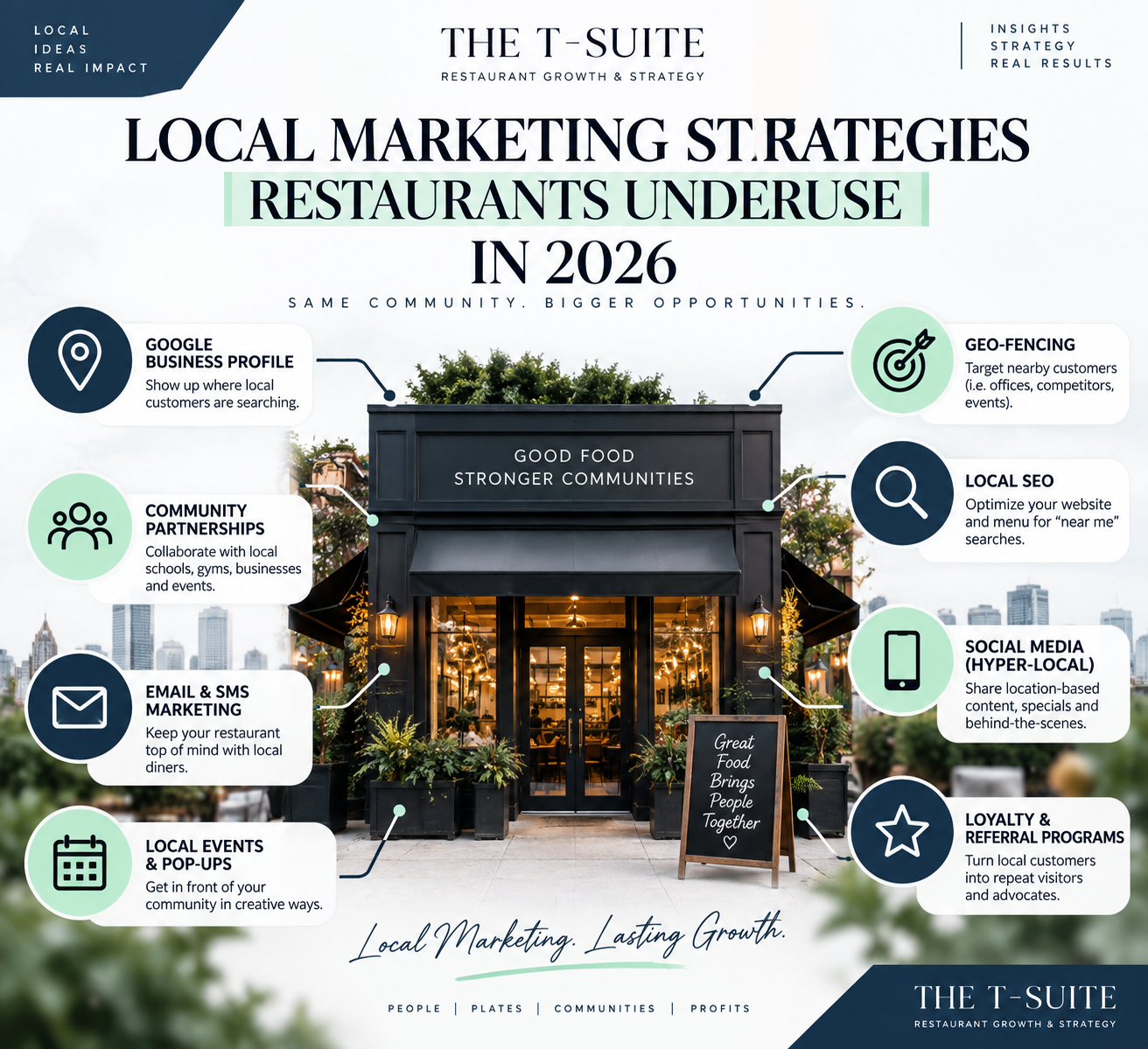
And How to Execute For Measurable Growth
Restaurants in 2026 are still competing in the same old digital spaces like Instagram ads, Google Ad’s, boosted posts, and influencer invites. Don’t get me wrong, those are great ways to carry out digital marketing strategies.
But you want to know the truth?
The restaurants quietly winning are dominating locally, not just digitally. There’s a harmonious dance your marketing efforts should flow through, and finding a balanced rhythm of local and digital marketing strategies will have your profits thanking you!
The operators in tune with local marketing aren’t just chasing impressions and trying to create viral content. They are also building physical, geographic, and community leverage, meeting their customers and potential customers where they are.
If you’re a restaurant operator looking to increase foot traffic, sales, and long-term customer retention, here are the most underused local marketing strategies in 2026.
1. Geo-Fencing Competitors
What is it?
Geo-fencing uses location based ads that trigger when someone visits a nearby competitor or high-traffic area (gyms, shopping centers, movie theaters, grocery stores). There’s essentially a virtual fence or boundary around a competitor’s business location. When target customers are within that virtual fence, they receive targeted ads (social media, apps, website banners), notifications, or special offers on their cell phones with the goal of redirecting them to your restaurant instead. Read a real-world case study to learn how Dave’s Hot Chicken used GroundTruth’s location and audience-based targeting strategies to drive return on ad spend and directly increase sales.
Why it works?
You’re targeting customers who are already spending money in your category and within your market.
Why it’s underused?
Most independent restaurants either don’t know what geo-fencing is or they assume it’s for large corporate restaurants. It is not. There are platforms such as Simpli.fi, GroundTruth, and even Meta’s location targeting that make it accessible to all operators.
How to Execute
Step 1: Define 5-10 strategic locations
- Direct competitors
- Large apartment complexes
- Gyms
- Shopping Centers
- Universities
Step 2: Create a specific offer
Be detailed. “Come try us!” won’t quite make the cut.
Consider instead:
- “Show this ad for a free appetizer.”
- “$10 lunch special, 11am-2pm only.”
- “Free dessert with entrée purchase.”
Step 3: Track redemption
Ways to track:
- A unique POS button
- Specific code word
- A QR code tied to campaign tracking
💡Pro Tip: Run geo-fencing during slow periods like Tuesday lunch or Sunday evenings.
2. Apartment & HOA Partnerships (The Goldmine Most Operators Don’t Tap Into)
It’s 2026 and multifamily living is exploding. Thousands of people live within walking distance of restaurants & yet most operators never build formal partnerships. 🤝
What This Looks Like
- Exclusive resident discount (10-15%)
- Monthly tasting event in clubhouse
- Catering resident appreciation events
- Custom QR code flyer in leasing office
How to Execute
- Call or visit the leasing office
- Ask, “Do you ever partner with local restaurants for resident perks?”
- Offer a simple flyer with:
- A QR code to your online ordering
- A resident-only discount code
Be sure to follow up quarterly.
This strategy works because residents want convenience, and who doesn’t like perks? If you become their default option, you win recurring revenue.
3. First-Time Guest Capture (Don’t Snooze on This Moment)
A new customer walking in is a rare opportunity, but most restaurants do nothing to capture them. In 2026, foot traffic without data is wasted traffic. Capturing new customers who visit your restaurant is so important for driving repeat business. Operators are able to convert a one-time visit into long-term brand loyalty through personalized touch points/follow-ups and intentional positive first impressions.
Simple Systems to Implement
- Wi-fi Gate
- Free wi-fi in exchange for email or phone number
- Send automated –
- Thank you message
- Bounce-back offer
- Review request
- Tabletop QR Code
“Scan for 10% off your next visit.”
This will help build:
- Email list
- SMS list
- Retargeting audience
Capturing first-time guests and being strategic about converting them to repeat customers is so powerful because returning customers spend more per visit, more frequently, and are more likely to refer others!
4. Community Calendar Domination
Instead of waiting for customers to discover you, attach yourself to what they’re already doing. Another example of meeting your target customers where they are.
Underused Opportunities
- Local church events
- Youth sports leagues
- Business networking groups
- Chamber events
- School Fundraisers
Execution Plan
- Identify 3 recurring local events per month
- Collect emails on site
- Offer bounce-back incentives
- Sponsor in small but visible ways:
- $100 gift card raffle
- Food table
- Branded napkins
The goal is to be physically present where your ideal customers gather, thus meeting your customers where they are.
5. Hyperlocal Content That Ranks on Google
In 2026, we’re all about intentionality. SEO is no longer about generic keywords. It’s time to combine intent + geography.
Instead of “Best Pizza in Town”, we’re digging deeper and being more specific with something like “Best Late-Night Food Near Alexandria, VA”.
Create content around:
- “Where to Eat After Church in Clinton, MD”
- “Best Family Dinner Spots Near Howard University”
- “Date Night Restaurants in 20002” (20002 zip code)
How to Execute
- Make a list of 10 hyperlocal phrases
- Write short blog posts (600-800 words)
- Optimize the title, meta description, and Google Business profile
- Embed a Google map
This will help you rank for real buyer intent searches. Intentionality all 2026!
6. Direct Mail
At some point, direct mail marketing stopped being as appealing as it once was. But because now most marketing efforts seem to be leaning more towards digital, physical mail stands out again in certain situations.
Best use cases:
- New restaurant launch
- New menu rollout
- Rebranding
- Slow season recovery
Execution Formula
- Oversized postcard
- Strong headline
- Limited-time offer
- Expiration date
- QR code to online ordering
Target:
- 1-3 mile radius
- High income Zip codes
- New move-ins list
Direct mail response rates for local restaurants can outperform digital ads when messaging is targeted and offers are strong.
7. “Slow Day” Flash Promotions via SMS
Don’t be the restaurant that randomly promotes. Instead, be intentional and use sales data. For example, if Tuesday 2-5 is your slowest window, text your list at 1:30pm something like “Flash Special: $8 wings until 5pm today only. Show this text.” According to Forbes (2024), SMS has an impressive open rate of 98%. That means you have more opportunities to engage your customers to help stimulate foot-traffic.
Scarcity + timing = foot traffic spike
This is simple revenue engineering most restaurants ignore.
The Bigger Picture
Local marketing in 2026 isn’t about being viral. It’s about being:
- Visible
- Embedded
- Trackable
- Repeatable
The restaurants that win are not necessarily the most creative. They’re the most consistent and data aware.
If you build these 5 methods in your local marketing strategies, you will build predictable revenue:
- A local partnership system
- First-time guest capture system
- Slow day recovery system
- A hyperlocal SEO system
Final Thought
Before spending another dollar on boosted social media posts, ask yourself:
- Have I partnered with every apartment complex nearby?
- Am I capturing first-time guests?
- Do I own my local email/SMS database?
- Am I ranking for neighborhood searches?
- Am I tracking slow day revenue patterns?
If you answered no to any of those questions, that’s where the growth is hiding.