
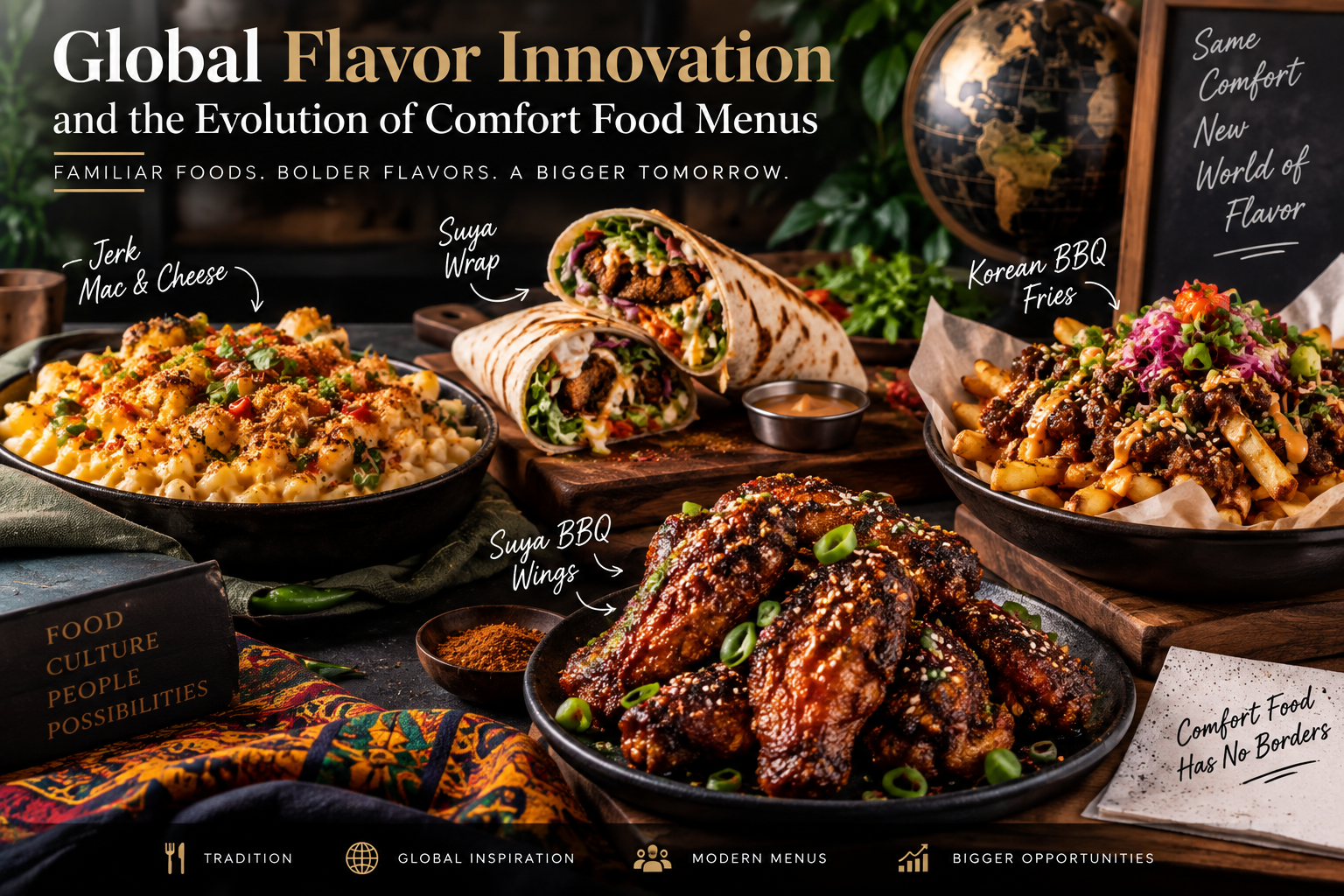
Comfort food has always been the foundation of American restaurant menus. Traditional American comfort foods are dishes that feel familiar and satisfying. But in today’s market, familiarity isn’t enough. Consumer tastes are ever evolving and global influences are becoming more mainstream which is leading to a transformation in comfort food.
As an American, when the thought of comfort foods come to mind, certain meals immediately shine. They are often associated with home cooked meals, regional traditions, and hefty serving sizes.
Examples of classic American comfort food staples include:
- Fried Chicken – Crispy, seasoned, and rooted in Southern tradition that consistently delivers on flavor and texture
- Burgers & Fries – A keystone in American dining featuring seasoned beef formed into a patty with endless options of toppings and add-on’s. French fries are served at different lengths/widths/shapes/cuts, various textures, diverse densities, and assorted potato types.
- Buffalo Wings – Bold, sauced, shareable, and a high margin item
- Hot Dogs – A simple classic which is often elevated by regional variations (New York-style, Chicago, Southern, etc.)
- Chicken Tenders – Breaded, fried golden, and normally paired with dipping sauces that enhance the flavor and perceived value
- Loaded Fries – A base of French fries layered with add-on’s like cheese, proteins, and sauces. It easily converts to a premium and shareable item
- Philly Cheesesteak – Thinly sliced beef and melted cheese often complimented with bell peppers, grilled onions, mushrooms, tomatoes, mayo, and/or ketchup for added depth
- Macaroni & Cheese – Baked and creamy is top tier in regard to flavor and texture, but stovetop options are also popular
- Shrimp & Grits – A southern favorite blending comfort and sophistication. If executed well, this can serve as a signature dish and a Star menu item
- Meatloaf & Mashed potatoes – A homestyle pairing that emphasizes warmth, a generous portion size, and nostalgic appeal. Similar to this appeal is chili and rice with a dollop of sour cream and possibly a piece of cornbread
- Biscuits & Gravy – Hearty buttery biscuits topped with a savory sausage gravy
- Chicken Pot Pie – Has a savory filling with a contrasted golden and flaky crust that delivers texture and comfort
- BBQ Ribs – Slow-cooked and tender with rich, smoky flavor and many regional variations
American comfort foods continue to perform but familiarity also presents a limitation. There are rarely differentiations from one menu to the next. Being in an increasingly competitive market with consumers being exposed to new cuisines and bold flavors, traditional comfort food is no longer enough to capture attention. Consumers and foodies alike are looking for novelty and flavors that cross global borders for harmonious fusion and flavor creativity.
Global flavor innovation is beginning to reshape the landscape.
Instead of replacing the American classics, forward thinking operators are building on top of them and layering globally inspired flavors on top of the familiar staples. That is resulting in a new category of menu items that feel recognizable and also exciting, yet fresh.
Think fusion dishes:
- Macaroni and cheese becomes jerk chicken mac and cheese.
- French fries transforms into Korean BBQ loaded shareables.
- Chicken wings are revamped with international flavors like gochujang and spicy harissa.
The strategy isn’t to reinvent comfort food. It’s to elevate it. When comfort is elevated, increasing menu prices makes sense. However, charging a premium for traditional and dated American comfort foods doesn’t justify higher tiered pricing.
In reimagining comfort food, restaurants are creating menus that satisfy cravings, spark curiosity, increase perceived value, and drive higher check averages.
📊 Data-Driven Insight: Why Global Flavor Innovation Is No Longer Optional
Global flavors are not just a trend. They are reshaping the market and there is clear consumer behavior data and operator response.
Consumer Demand Is Already Here
According to DATASSENTIAL, 47% of US consumers have eaten globally influenced food in the past seven days, and that percentage is up 68% from 2017, when it was just 28%. What does this mean for operators? It means global flavors are no longer considered a niche. They are becoming a part of mainstream eating habits across the nation, especially in urban cities where it’s typically diverse.
Operators Are Responding to the Shift
- Industry reports show 70% of restaurant owners and operators have reported an increased demand for global flavors from their customers.
This means:
- If your menu isn’t progressing, you can believe your competitors are
- Global flavors are becoming a standard anticipation, not a differentiator
Check out operators who have responded to the shift in global flavor innovation in the northeast region:
- Indochen in Alexandria, VA
- Cuts & Slices in Brooklyn, NY
- Bros J Suya in Beltsville, MD
- Soul Wok in District Heights, MD
- Allentown Kitchen in Fort Washington, MD
- Spiced Black in Upper Marlboro, MD
Consumers Want Both Familiarity and Discovery
- In 2017, DATASSENTIAL reported 28% of customers had consumed at least one globally influenced dish in the past week. By 2025, that number had jumped to 47%
- Although consumers are actively seeking global flavors, comfort, value and familiarity remain top decision drivers
This creates potent opportunities:
- Safe + New = Increased engagement
- Familiar + Elevated = Higher perceived value
What This Means for Menu Strategy
Restaurants that successfully combine the following:
- Comfort, connecting to emotions
- Global flavors, creating novelty
- Value, appealing to perception
They are aligning with exactly where the market is trending towards. Comfort food is here to stay, but the way it shows up is transforming. Nostalgic staple dishes are being reshaped through global influence, fusion flavor profiles, and intentional menu design. Successful operators are not replacing their core items, they are amplifying them in ways that evoke familiarity and newness.
This is where real opportunities and whitespace opportunities lie.
How Operators Can Execute
Incorporating global flavor profiles doesn’t require the entire menu to be changed, new equipment, or retraining of the kitchen staff. It’s best to treat it as a layering strategy. Below are tangible steps to execute this layering strategy in a way that drives revenue and avoids chaos:
- Start With What You Currently Sell
One of the biggest mistakes operators make is thinking completely new dishes are needed to get started. That’s not the case at all. The best performing items are often familiar formats blending global flavors.
Some core top sellers include:
- Fries
- Wings
- Tacos
- Mac & cheese
- Rice bowls
Then apply one global inspiration:
- Korean BBQ sauce
- Jerk seasoning
- Butter chicken sauce
- Harissa glaze
- Suya seasoning
For example, regular French fries transform to Korean BBQ loaded fries and mac & cheese mutates to jerk chicken mac & cheese. Approaching the strategy in this way accomplishes a few things:
- Minimizes operational friction
- Keeps prep simple
- Maximizes perceived innovation
- Menu elevation
Pro tip: Work with your supplier to get a free sample case of the global items you plan to incorporate. It’s a great method because you have the opportunity to test your ideas without increasing food cost. If you don’t have a good relationship with your purveyor, it’s time to start working it. Check out this article about building a strong relationship and partnership with your food distributor.
- Build Around 1-2 “Anchor Items”
You don’t even need 5 global dishes to get started. All that’s really needed is 1-2 items that resonate. Those 1-2 items will become your social media drivers, upsell opportunities, and differentiators.
Ask yourself a couple questions:
- What would someone post on IG?
- What would someone drive 20 minutes to try?
Make sure the focus is on bold flavors, visual presentation and appeal, and share-ability.
- Cross Utilize Ingredients to Protect Margins
Execution takes a hit when food costs become unmanageable. The goal is to introduce global flavor without complexity.
Examples of cross utilizing ingredients:
- Use the same grilled chicken → jerk, butter chicken, shawarma seasoning, curry chicken
- One sauce base → twist into many flavor profiles
- Existing sides → elevated with global toppings
This will allow you to keep inventory tight, minimize waste, and maintain margins. Innovation is used to increase profits, not dilute it.
- Price for Perceived Value and Not Just Cost
Global innovations allow you to increase prices without resistance. The reason why is because customers perceive cultural authenticity, culinary creativity, and something new.
Example:
Regular fries ⎯ $3.99
Loaded global fries ⎯ $8.99 – $12.99
The base product is the same, but the margins are completely different. Be sure to not make the mistake of underpricing these items. They are considered premium experiences, not just add-on’s.
- Train Staff to Sell the Experience
Your staff shouldn’t just be order takers. They should be trained to introduce the new item. Train them with very simple language:
- “That’s one of our most popular items right now”
- “It’s a twist on classic mac & cheese with jerk flavor”
- “A lot of customers come in specifically for this”
Training staff to approach selling the experience increases check averages and helps build curiosity and trust. Do not sleep on this step!
If your staff isn’t talking about it, customers won’t know about it or buy it.
- Launch It Like a Moment, Not a Menu Item
Don’t add it to the menu. Make it feel like an experience and a drop.
Execution ideas:
- “New This Week” feature
- Limited time offer (even if you have plans to retain it)
- Staff tastings before the actual launch
- Social media teaser content
Create urgency and excitement. People try what feels new and popular.
- Watch, Learn, and Expand
Once you’ve proven your first item is successful, identify what worked well such as flavor, format, and presentation.
Example:
- Korean BBQ fries succeed → add Korean BBQ wings
- Jerk mac & cheese succeeds → add jerk tacos
That’s a way to build a menu ecosystem and not just random items. Again, the goal is to utilize what you’re already using and what’s working versus overhauling the menu.
Execution Insight
Global flavor innovation isn’t about chasing trends. It’s all about translating familiarity through new optics. The operators who win are not the ones who add the most items. They’re the ones who take what’s already performing well and revamp it by making it feel new, desirable, and deserving of attention.
Closing
By beginning with proven, standard comfort food and strategically incorporating global flavors, restaurants can increase perceived value, drive higher check averages, and create menu items that stand out in a competitive market. The goal isn’t to chase the latest trend because trends come and go. The goal is to apply current trends with intentionality and purpose.
When executed correctly, global flavor innovation doesn’t complicate the menu. On the contrary, it upgrades it. Familiar foods produce comfort. Global flavors create interest and curiosity.
The proper combination drives revenue.
Want more insights like this? Join the T-Suite newsletter for weekly restaurant strategy breakdowns.