Many restaurants want higher average checks, but the problem isn’t always the menu items. Sometimes, the opportunity is actually sitting at the table. Often, staff isn’t trained to guide guest ordering decisions and they haven’t been shown how to effectively recommend menu items.
A guest orders a burger but is never told about the premium side. A couple orders entrees, but skips appetizers because nothing was recommended. The server brings the check to the table without recommending dessert options.
These examples may seem like small missed opportunities, but across hundreds and even thousands of transactions, they can add up to substantial unrealized revenue.
Increasing average check doesn’t mean pushing guests to spend more. The best restaurants train their teams to make thoughtful recommendations that enhance the guest experience. It’s about training employees to recognize opportunities that help improve the dining experience while helping guests discover options they may genuinely enjoy.
Staff should be guiding their customers toward recommendations that add value. Today, diners are more intentional with their spending. They work hard for their money and have an expectation that it will translate into something enjoyable and memorable. When the experience delivers, the spend naturally follows.
When done correctly, upselling feels like hospitality, not selling.
Even small improvements can create major impact:
Example:
- 150 guests per day
- +$2 average check increase
- = $300 more revenue per day
- = $109,500 annually
The difference comes down to how staff communicate with guests.
Stop Teaching Staff to Upsell and Train Them to Recommend
The word upselling itself can create the wrong mindset. Who likes to be “sold” to? Feeling like you’re being “sold” to feels cold and impersonal. Guests respond better to recommendations rather than sales language.
Instead of:
- “Do you want to add anything?”
- “Do you want to fries with that?”
- “Would you like an appetizer?”
- “Do you want dessert?”
These questions aren’t necessarily bad, but they’re easy to decline. More importantly, they don’t give the guest a compelling reason to say yes.
Train staff to make recommendations:
- “If you’re sharing, I love the crispy shrimp. It’s one of our most popular starters and it’s enough for the table.”
- “A lot of guests add salmon to that dish.”
- “Our homemade lemonade is really refreshing and pairs well with the barbecue ribs.”
- “The brownie Sunday or red velvet cake would be a nice dessert after that meal.”
This approach feels natural and helpful rather than awkward and forced.
Start With Product Knowledge
It’s difficult for employees to recommend products they don’t fully understand. Before teaching sales techniques, ensure the team knows the menu.
Staff should be able to confidently answer questions such as:
- Which appetizers are best for sharing?
- Which sides can guests upgrade to?
- Which beverages pair well with popular entrees?
- Which menu items are restaurant specialties?
- Which desserts and appetizers are sharable?
- What add-ons or modifiers improve popular dishes?
- Which items offer strong value for the guest?
Whenever possible, allow the employees to taste the food. There’s a major difference between an employee saying:
“Our loaded fries are really popular.”
VS
“If you like a little heat, I’d upgrade to the loaded fries. They have our signature house sauce, jalapeno peppers, and creamy cheddar cheese for dipping. I get them anytime I order the burger.”
Specificity makes recommendations resonate more and genuine enthusiasm is difficult to script.
Operators should identify 3–5 high-margin items the team should recommend consistently.
Examples include:
- Specialty drinks
- Appetizers
- Premium sides
- Dessert
- Add-on proteins
Keep the list short so staff can remember and confidently suggest them.
Example upgrade recommendation flow:
- Drinks
- Appetizer or starter
- Add-ons or upgrades
- Dessert
This creates various opportunities to increase the check average.
Train Every Position (Not Just Servers)
Recommendations shouldn’t be limited to servers. When everyone is working toward the same goal, that’s when synergy is ignited.
Hosts
Hosts actually influence the very first buying decision.
Examples:
- “I’ll get you a menu to look over while your table is prepared. In the meantime, would you like to start with one of our house lemonades?”
- “Today’s special dessert is sweet potato pie.”
Servers / Cashiers
Servers should focus on pairing recommendations.
Examples:
- “Many guests add shrimp to that pasta.”
- “Our cornbread pairs really well with that dish.”
Managers
Managers reinforce upgrading through coaching and incentives.
Managers should:
- Recognize staff members who upsell effectively
- Review average check performance
- Coach employees before and after shifts
When managers reinforce it, upselling becomes part of the restaurant culture.
Use Bundles to Increase Check Size
Bundles simplify decisions for guests. Customers find it easier to choose when options are laid out, intentional and not overwhelming.
For example, instead of:
Catfish – $12
Sides – $4 each
Offer:
Catfish Dinner – $18
Includes fries and coleslaw
Bundle deals encourage guests to spend more without thinking about individual items.
Teach the “One Recommendation” Rule
Restaurants can easily go too far with upselling.
A server who recommends an appetizer, premium side, extra protein, second drink and dessert during every interaction can quickly make guests feel like they’re being sold to.
Instead, teach employees to identify one strong opportunity at each relevant stage of the meal.
The recommendation should make sense based on what the guest has already ordered.
If someone orders wings, recommend the house dipping sauce.
If a table orders several entrées, mention a shareable appetizer.
If two guests are lingering after dinner, recommend a dessert they can split.
This makes the interaction feel personalized rather than transactional.
Don’t Treat Every Menu Item Equally
Increasing average check isn’t simply about selling more food.
Operators should consider what employees are recommending.
A $4 add-on with a strong contribution margin may be more valuable than encouraging a guest to choose a more expensive entree with a much higher food cost.
Work with managers and kitchen leadership to identify a short list of items that are worth highlighting.
Consider:
- Premium sides
- Specialty beverages
- Appetizers
- Desserts
- Sauces
- Protein additions
- Toppings
- Size upgrades
- Meal enhancements
The objective isn’t necessarily to promote the most expensive items. It’s to identify options that make sense for both the guest and the restaurant’s profitability strategy.
Make It a Game Without Making Guests the Target
Friendly competition can help reinforce good habits.
Restaurants can track metrics such as:
- Appetizer attachment rate
- Beverage attachment rate
- Dessert sales
- Premium side upgrades
- Average check
- Featured-item sales
Recognize improvement rather than only rewarding the employee with the highest sales.
For example, an employee who increases their average check from $24 to $27 may deserve more recognition than someone who consistently averages $32 but hasn’t improved.
This keeps the focus on skill development.
Just be careful with incentives that encourage employees to recommend products regardless of whether they make sense for the guest.
The guest experience still comes first.
Train Hospitality First, Sales Second
The best restaurant salespeople often don’t feel like salespeople at all.
They listen, understand the menu, notice what guests enjoy, make confident recommendations, and they know when to stop selling.
A guest who says, “We’re good for now,” shouldn’t hear three additional pitches.
A guest celebrating a birthday, on the other hand, may appreciate hearing about the restaurant’s signature dessert.
Context always matters.
Train employees to read the table rather than recite a script.
Build Upgrading Into the Restaurant’s Culture
One training session won’t permanently change employee behavior. Reinforcement should happen continuously.
Pre-shift meetings are a great way to introduce a featured item. Also, allowing employees taste new products gives them firsthand experience. As mentioned earlier, it will give them the opportunity to display genuine enthusiasm with guests when talking about it.
Understand your customers better by asking staff which recommendations guests respond to. Working together as a team by sharing successful recommendations employees have used is also helpful.
Keep in mind to review average-check trends and celebrate improvement.
Over time, recommending becomes less of a “sales technique” and more of a normal part of hospitality. That’s where the real opportunity lies.
Restaurants don’t necessarily need higher prices to generate more revenue from existing traffic.
Sometimes they simply need to help guests discover more of what the restaurant already has to offer.
Turn This Strategy Into a 10-Minute Pre-Shift Training
Knowing what to do is one thing. Getting an entire team to consistently do it during service is another.
Restaurants that consistently increase average check usually:
- Talk about upselling/upgrading during pre-shift meetings
- Track average check trends
- Celebrate employees who do it well
Small habits create big long-term revenue gains.
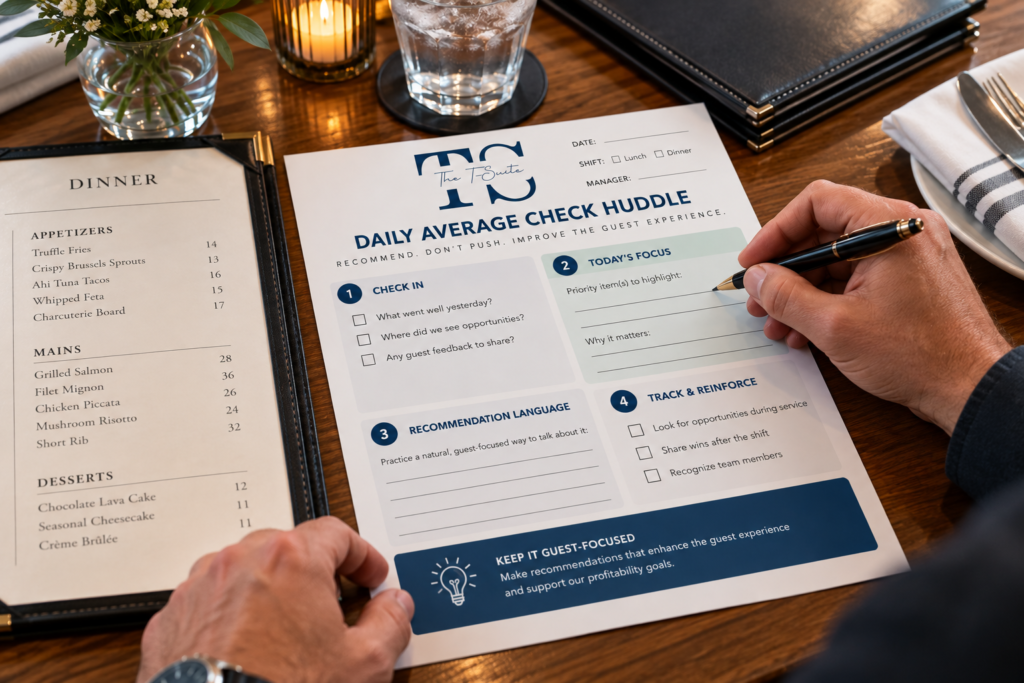
The T-Suite Daily Average Check Huddle gives restaurant managers a simple, repeatable framework for leading productive pre-shift conversations. It helps teams recognize what’s working, identify a daily focus item, practice natural recommendation language, and uncover opportunities to increase average check, all while keeping the focus on improving the guest experience rather than pushing a sale.
Download the Daily Average Check Huddle and Manager Guide below ⬇
The T-Suite Takeaway
Increasing average check shouldn’t begin with the question, “How can we get customers to spend more”?
Instead, start with:
“How can we help guests build a better experience?”
When employees know the menu, understand which recommendations make sense and have the confidence to communicate them naturally, better hospitality and stronger restaurant revenue can happen at the same time.